ELSS Funds Guide 2026: Save Tax & Build Wealth with 3-Year Lock-in
Equity Linked Savings Scheme (ELSS) has become the go-to tax-saving investment choice for young Indians who want to combine tax benefits with wealth creation potential. Unlike traditional tax-saving options like PPF and fixed deposits, ELSS offers the dual advantage of equity market exposure and the shortest lock-in period of just 3 years.
What is Equity Linked Savings Scheme (ELSS)?
Equity Linked Savings Scheme (ELSS) is a type of mutual fund that primarily invests in equity and equity-related instruments while offering tax deduction benefits under Section 80C of the Income Tax Act. You can calculate your tax benefits using our Income Tax Calculator.
- ✓Investment Type: At least 80% in equity.
- ✓Tax Benefits: Section 80C (Max ₹1.5L).
- ✓Lock-in: 3 years (Shortest).
- ✓Returns: 12-15% (Historical).
- Invest: Fund manager builds equity portfolio.
- Lock: Money locked for 3 years.
- Tax Save: Claim deduction in ITR.
- Grow: Wealth grows with market.
- Redeem: Sell or hold after 3 years.
Why Choose ELSS for Tax Saving?
| Investment Option | Lock-in Period |
|---|---|
| ELSS Mutual Fund | 3 years ✅ |
| National Savings Certificate (NSC) | 5 years |
| Tax Saver FD | 5 years |
| Public Provident Fund (PPF) | 15 years |
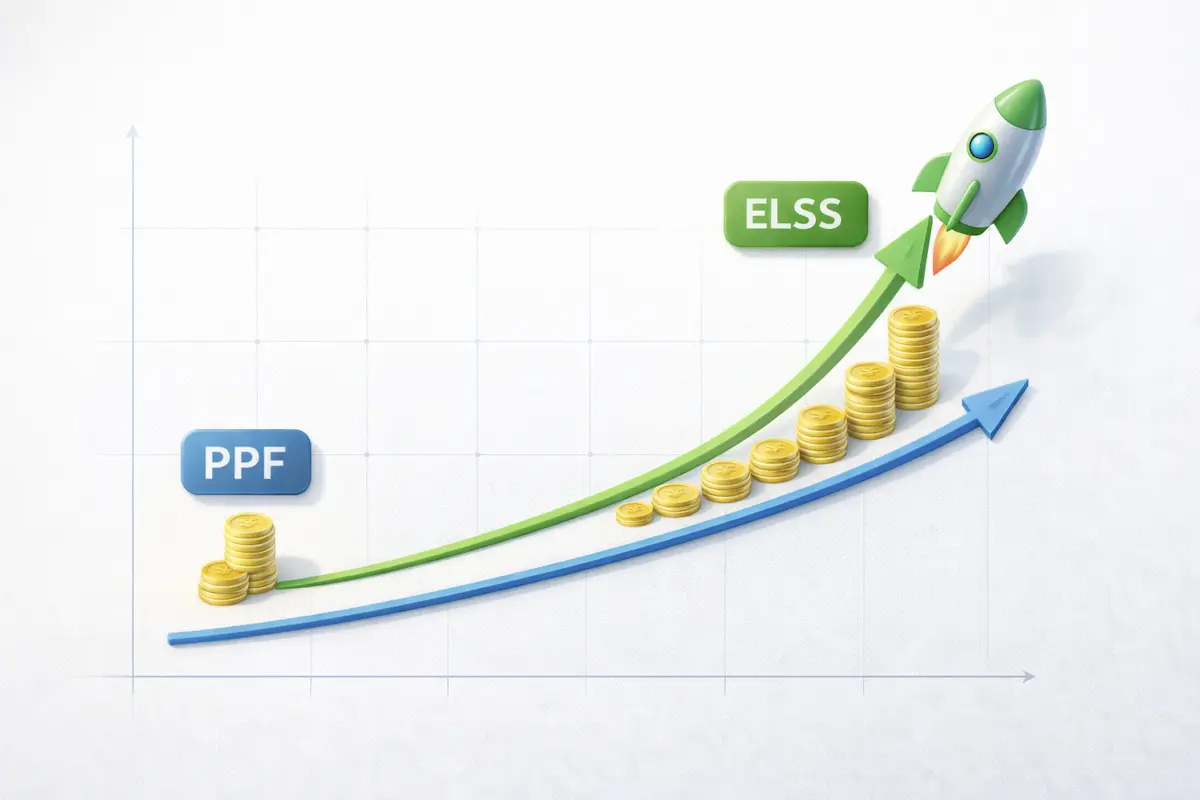
While past performance doesn't guarantee future returns, the equity exposure in ELSS provides growth potential that fixed-income instruments cannot match. Historical averages show ELSS delivering 12-15% vs PPF's 7.1%. Check real returns using our Inflation Calculator.
Deduction at Investment
Investments up to ₹1,50,000 per financial year qualify for deduction. This amount is deducted from your gross total income before calculating tax.
If you are in the 30% tax bracket and invest ₹1,50,000 in ELSS:
Tax Saved = ₹46,800 (30% of ₹1.5L + Cess).
Effective cost of investment = ~₹1,03,000.
Tax on Returns (LTCG)
- Long-Term Capital Gains (LTCG): Gains up to ₹1.25 Lakh per year are Tax-Free.
- Above ₹1.25 Lakh: Taxed at 10% without indexation.
ELSS vs PPF vs FD: Complete Comparison
| Parameter | ELSS | PPF | Tax Saver FD |
|---|---|---|---|
| Returns | 12-15% (Market) | 7.1% (Fixed) | 5.5-7% (Fixed) |
| Lock-in | 3 Years ✅ | 15 Years | 5 Years |
| Risk | High (Equity) | Zero (Govt) | Low (Bank) |
| Tax Status | LTCG > 1.25L Taxed | EEE (Tax Free) ✅ | Interest Taxable |
| Best For | Wealth Creation | Retirement | Capital Safety |
Historical Returns & Risk
| 3 Years | 16-20% |
| 5 Years | 15-19% |
| 10 Years | 13-16% |
Market Risk: NAV can fall during market downturns.
Lock-in Risk: You cannot access funds for 3 years.
Manager Risk: Performance depends on stock selection.
How to Choose & Invest
- Long-Term Track Record: Look for consistent performance over 5-10 years.
- Expense Ratio: Lower is better. Always choose Direct Plans.
- Portfolio Quality: Ensure diversification across sectors.
Invest fixed amount monthly. Reduces timing risk via Rupee Cost Averaging. Use our SIP Calculator to plan.
One-time investment. Good if you have bulk cash, but carries high market timing risk.
Redemption & Mistakes
After 3-Year Lock-in
- Full Redemption: Withdraw everything if you need funds.
- Partial Redemption: Withdraw only what you need.
- Continue Holding (Best): Let compounding work for 5-7+ years.
Mistakes to Avoid
- Investing only for tax saving.
- Waiting until March for lump sum.
- Redeeming immediately after 3 years.
- Chasing last year's top performer.
- Choosing Regular plans over Direct.
Conclusion: Is ELSS Right for You?
ELSS combines the best of both worlds – tax saving today and wealth creation for tomorrow. It is ideal for young professionals and investors with a 5+ year horizon.
FAQs: ELSS Mutual Funds
Fincado Research Team
Fact CheckedOur analysis is built on deep-dive research into RBI Benchmarks and lender-specific disclosures. We verify every interest rate and fee structure against real-world borrower approvals to ensure the highest level of accuracy for Indian home buyers.
Disclaimer: Mutual Fund investments are subject to market risks, read all scheme related documents carefully. The past performance of mutual funds is not necessarily indicative of future performance. This article is for educational purposes only and does not constitute financial advice. Please consult a tax advisor before making investment decisions.