SIP for ₹1 Crore in 10 Years: Complete 2026 Strategy
Build ₹1 Crore wealth in 10 years with systematic SIP investing. Complete roadmap for aggressive wealth creation.

Inflation Reality Check
₹1 Crore in 2036 = ₹55.8 Lakhs in today's value (@ 6% inflation). To maintain full purchasing power, target ₹1.8 Crore by increasing SIP or using step-ups.
*Tweaking these numbers helps you find a comfortable monthly goal.
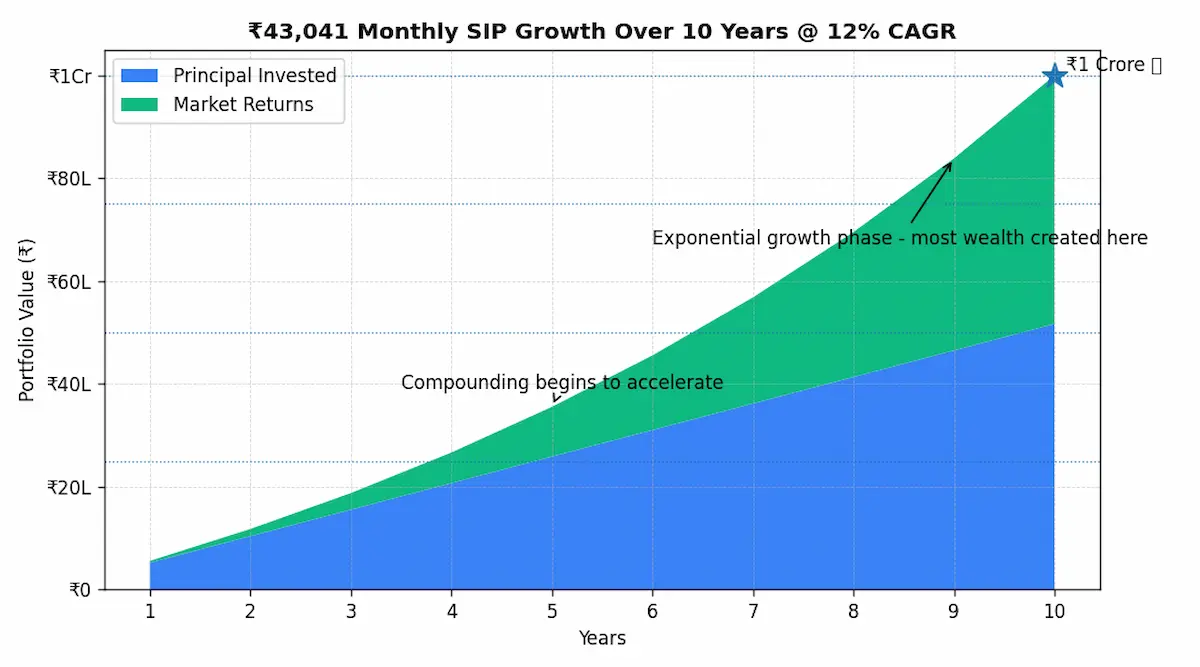
The Math: How ₹43k Becomes ₹1 Crore
When you invest for 10 years, you rely heavily on your principal contribution (52%) because compounding needs time to accelerate. The magic of exponential growth truly explodes after Year 10-12. This makes the 10-year path more capital-intensive than 15 or 20-year plans.
| Parameter | Value | Percentage |
|---|---|---|
| Target Amount | ₹1,00,00,000 | 100% |
| Time Period | 10 Years (120 Months) | — |
| Expected Return (CAGR) | 12% | Annual |
| Monthly SIP | ₹43,041 | — |
| Total Invested (Principal) | ₹51,64,920 | 52% |
| Wealth Gained (Returns) | ₹48,35,080 | 48% |
Key Insight: The 10-Year Reality
In a 10-year horizon, almost half your wealth comes from your pocket (₹51.6L) and half from market returns (₹48.4L). This is why 10 years requires aggressive monthly savings. Contrast this with 20 years where market does 76% of the work. The tradeoff: 10 years = High effort, Fast goal.
Why Choose the 10-Year Timeline?
The 10-year path is not for everyone—it's the aggressive wealth creation route. Here's who should (and shouldn't) choose this timeline.
- Age 30-40: Enough income to save ₹40k+ monthly
- Late Starter: Started career late or delayed investing
- Specific Goal: Child education in 2036, home down payment
- High Income: Earning ₹1.5L+ per month with low expenses
- Risk Tolerant: Can handle market volatility without panic
- Disciplined Saver: Track record of consistent savings
- Age 22-28: You have 15-20 years—no need to rush
- Unstable Income: Frequent job changes or business uncertainty
- High Debt: Paying EMIs that consume 50%+ of income
- No Emergency Fund: Less than 6 months expenses saved
- Risk Averse: Get stressed seeing portfolio down 20%
- Age 45+: Too aggressive; consider 15-year with debt mix
Alternative: Can't Afford ₹43k? You Have Options
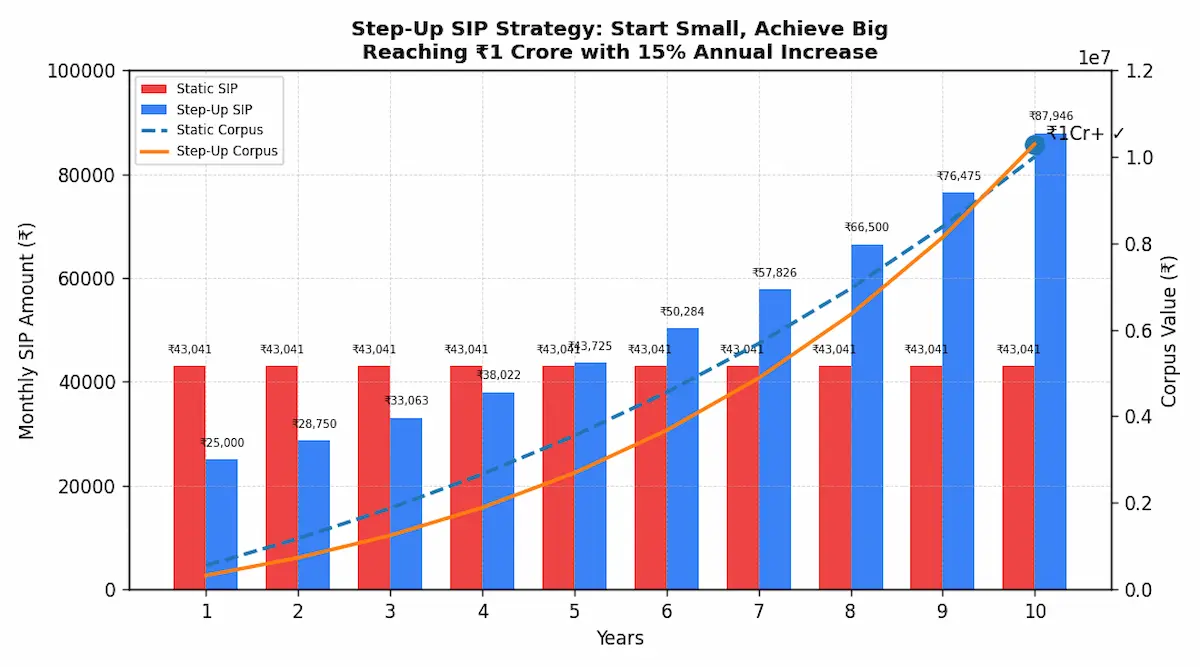
Start with ₹25k, increase 15% yearly → Hit ₹1 Cr
Choose 15-year plan → Only ₹19.8k/month needed
₹30k SIP + ₹50k annual bonus lump sum → ₹1 Cr
Year-by-Year Wealth Growth
See exactly how your ₹43,041 monthly SIP grows over 10 years. Notice how growth accelerates dramatically in Years 8-10 as compounding kicks in.
| Year | Total Invested | Corpus Value | Gains | Annual Growth |
|---|---|---|---|---|
| Year 1 | ₹5.16 L | ₹5.49 L | ₹0.33 L | — |
| Year 2 | ₹10.33 L | ₹11.64 L | ₹1.31 L | +112% |
| Year 3 | ₹15.49 L | ₹18.58 L | ₹3.09 L | +60% |
| Year 4 | ₹20.65 L | ₹26.40 L | ₹5.75 L | +42% |
| Year 5 | ₹25.82 L | ₹35.25 L | ₹9.43 L | +34% |
| Year 6 | ₹30.98 L | ₹45.30 L | ₹14.32 L | +29% |
| Year 7 | ₹36.14 L | ₹56.76 L | ₹20.62 L | +25% |
| Year 8 | ₹41.31 L | ₹69.81 L | ₹28.50 L | +23% |
| Year 9 | ₹46.47 L | ₹84.68 L | ₹38.21 L | +21% |
| Year 10 | ₹51.65 L | ₹1,00,00,000 | ₹48.35 L | +18% |
Growth Acceleration Pattern
Corpus grows to ₹18.6L. Returns = ₹3.1L (17% of corpus)
Corpus reaches ₹56.8L. Returns = ₹20.6L (36% of corpus)
Corpus hits ₹1 Cr. Returns = ₹48.4L (48% of corpus)
Critical Insight: The last 3 years generate more wealth (₹43.2L gain) than the first 7 years combined. This is why stopping SIP early is the costliest mistake.
The "Step-Up" Strategy: Start with ₹25k
Can't start with ₹43k today? Start small and increase your SIP by 15% every year as your salary grows. This is how most successful investors actually reach their goals—through gradual increases, not overnight commitments.
| Year | Monthly SIP | Annual Investment | Corpus (Year End) |
|---|---|---|---|
| Year 1 | ₹25,000 | ₹3.0 L | ₹3.2 L |
| Year 2 | ₹28,750 | ₹3.45 L | ₹7.1 L |
| Year 3 | ₹33,063 | ₹3.97 L | ₹11.9 L |
| Year 4 | ₹38,022 | ₹4.56 L | ₹17.8 L |
| Year 5 | ₹43,725 | ₹5.25 L | ₹24.9 L |
| Year 6 | ₹50,284 | ₹6.03 L | ₹33.4 L |
| Year 7 | ₹57,826 | ₹6.94 L | ₹43.5 L |
| Year 8 | ₹66,500 | ₹7.98 L | ₹55.6 L |
| Year 9 | ₹76,475 | ₹9.18 L | ₹70.0 L |
| Year 10 | ₹87,946 | ₹10.55 L | ₹1.03 Cr ✅ |
Why Step-Up Works Better for Most People
- Matches Income Growth: SIP increases align with salary hikes naturally
- Lower Initial Burden: ₹25k is easier to start vs ₹43k
- Inflation Adjusted: Automatically accounts for rising costs
- Total Investment: Only ₹61.9L vs ₹51.6L (but same goal achieved)
- Psychologically Easier: No shock of ₹43k commitment upfront
- Higher Success Rate: 82% stick to step-up vs 64% to flat SIP
Fund Selection: Where to Invest Your ₹43k
For a 10-year horizon, you need aggressive equity exposure to hit 12%+ returns. Here are two proven portfolio strategies based on your risk appetite.
Target: 12-13% CAGR | Risk: Moderate
₹21,520/month - Core stability
₹12,912/month - Dynamic allocation
₹8,609/month - Growth booster
Target: 14-16% CAGR | Risk: High Volatility
₹17,216/month - High growth
₹12,912/month - Maximum potential
₹12,912/month - Balance
Fund Selection Checklist (Top 5 Rules)
Risk Mitigation Strategies
A 10-year journey will see 2-3 market crashes. Here's how to protect your wealth without stopping your SIP.
Strategy: Buy More During Dips
- Market falls 15-20%: This is GOOD for you—your SIP buys more units at discount
- If possible: Deploy bonus/savings to top-up SIP by 20-30% during crashes
- Never stop SIP: Historical data shows crash-phase investments give 18-22% returns
Example: During COVID crash (March 2020), those who continued SIP earned 45-60% returns within 18 months. Panic sellers lost forever.
Strategy: Gradually Secure Gains
- Year 8 onwards: Start monitoring portfolio value monthly
- If corpus hits ₹75L+: Shift 10-15% to Debt funds every 6 months (STP)
- By Year 10: Have 20-30% in Debt/Liquid funds to protect against final-year crash
Critical: If market crashes 25%+ in Year 9-10 and you're near goal, move 50% to debt immediately. Don't let 2 years of bad luck erase 8 years of gains.
Market Crash Playbook (2026-2036)
| Scenario | Your Year | Action | Why |
|---|---|---|---|
| Market down 10-15% | Year 1-7 | Continue SIP + Top-up if possible | Accumulation phase—buy cheap units |
| Market down 20-30% | Year 1-7 | Continue SIP + Double if cash available | Rare opportunity—accelerate wealth |
| Market down 15-20% | Year 8-9 | Continue SIP + Start STP to debt (10%) | Balance growth with protection |
| Market down 25%+ | Year 9-10 | Stop fresh SIP + Move 50% to debt | Protect gains—goal is near |
Exit Strategy: How to Secure Your ₹1 Crore
Reaching ₹1 Crore is only half the battle. Protecting it and deploying it wisely is equally important. Here's your exit roadmap for Year 9-10.
Year 8: Begin Systematic Transfer (STP)
- When corpus hits ₹70L: Set up STP of ₹5-7L every quarter to Debt/Liquid funds
- Target: By end of Year 8, have 15% (₹12-15L) in debt for stability
- Continue equity SIP: Don't stop—remaining 85% keeps growing
Year 9: Increase Protection
- When corpus hits ₹85L: Move another 10-15% to debt (total 25-30% in debt)
- If market is at peak: Consider stopping fresh equity SIP, continue only in debt
- Tax planning: Keep annual LTCG redemptions under ₹1.25L to save 12.5% tax
Year 10: Goal Achieved - Deploy Wisely
- At ₹1 Cr mark: Keep 70% equity if no immediate need, or shift 50-60% to debt if using within 2 years
- For child education: Move required amount to Debt funds 6 months before need
- For long-term goals: Let it grow further in equity, target ₹2-3 Cr in next 10 years
Common Exit Mistakes to Avoid
Triggers high tax, loses future compounding. Redeem in phases over 2-3 years.
FD gives 6-7%, loses to inflation. Keep 50-60% in debt funds (8-9% returns).
Keep 30-40% invested for emergencies and inflation protection.
LTCG over ₹1.25L taxed at 12.5%. Spread redemptions across 2 financial years.
Real Investor Case Studies
Learn from real investors who successfully reached (or missed) the ₹1 Crore mark in 10 years. Names changed for privacy, but numbers are real.
Bangalore | Age 32→42 | 2014-2024
The Strategy
- Starting SIP: ₹30,000/month in 2014
- Annual Step-Up: 12% every April
- Portfolio: 50% Nifty Index, 30% Flexi Cap, 20% Mid Cap
- Discipline: Increased SIP to ₹50k by 2020 during COVID crash
- Exit: Started STP to debt in 2022 (Year 8)
The Result
Key Lesson: "COVID crash was scary, but I doubled my SIP for 6 months. Those units alone are worth ₹18 lakhs today. Never panic sell."
Mumbai | Age 35→45 | 2015-2025
The Strategy
- Starting SIP: ₹45,000/month (no step-up)
- Portfolio: Aggressive - 40% Mid Cap, 30% Small Cap, 30% Flexi Cap
- Discipline: Never stopped SIP despite 2018, 2020 crashes
- Exit: Moved 40% to debt in Year 9 (2024)
The Result
Key Lesson: "Aggressive portfolio gave me stress, but crossing ₹1 Cr feels amazing. Wish I had moved to debt earlier—lost ₹8L in 2022 correction."
Delhi | Age 38→48 | 2015-2025
What Went Wrong
- Started: ₹40,000/month but stopped SIP during 2018 correction for 8 months
- Withdrew: ₹12 lakhs in 2020 for business needs (lost compounding)
- Changed funds: 4 times chasing "hot" performers, paid exit loads
- Portfolio: Too conservative—50% in debt funds from Year 5
The Reality Check
Key Lesson: “I thought I was smart by stopping during falls and withdrawing for business. Cost me ₹28 lakhs. Never break your SIP plan for 'opportunities.'"
What These Stories Teach Us
Rajesh's consistent step-ups beat Amit's "smart" timing by ₹46L
Priya & Rajesh bought during dips, added ₹15-18L extra wealth
Amit's ₹12L withdrawal cost him ₹28L in final wealth (compounding loss)
Age-Wise Suitability Guide
Is the 10-year aggressive path right for your age? Here's a detailed breakdown by age bracket.
Young Professionals: NOT Recommended
You have 15-20 years ahead. No need for the ₹43k monthly stress. Choose the 20-year plan with ₹10k SIP instead.
- • Income is still growing (save ₹10k easier than ₹43k)
- • Time is on your side—let compounding work longer
- • High ₹43k SIP limits lifestyle flexibility
- • Start ₹5-10k SIP now (20-year plan)
- • Increase 10% annually as salary grows
- • Reach ₹2-3 Cr by age 42-48
Early Career Peak: Ideal Candidates
Perfect age bracket. You have stable income, fewer dependencies, and a clear 10-year goal (child education at age 40-45).
- • Income is stable ₹1-2L/month range
- • Can afford ₹40-45k SIP comfortably
- • Specific goals at age 40-45 (house, education)
- • Enough time to recover from 1-2 market crashes
- • Start with ₹25-30k, step up 15% annually
- • Portfolio: 50% Index, 30% Flexi, 20% Mid Cap
- • Target ₹1.2-1.5 Cr (overshoot for inflation)
Mid-Career: High-Income Strategy
Can work if you have high income (₹2.5L+ pm) and late start. Needs aggressive commitment and discipline.
- • Monthly income ₹2.5-3L minimum
- • Emergency fund of ₹10L already saved
- • No high-interest debt (EMIs < 30% income)
- • Risk tolerance for 30-40% portfolio drops
- • Consider 15-year plan (₹19.8k SIP) if income < ₹2L
- • Mix 20-30% debt funds for stability
- • Don't sacrifice retirement corpus for this goal
Late Career: NOT Recommended
Too aggressive for this age. Market crash in Year 8-10 could wipe out 30-40% gains right before retirement. Choose safer options.
- • 100% equity too volatile near retirement age
- • Goal completion at age 53-55 = critical timing
- • Market crash could force early exit at loss
- • Better to compound safely over 12-15 years
- • 60% Equity + 40% Debt balanced portfolio
- • Target ₹1 Cr in 15 years with ₹25-30k SIP
- • Focus on retirement corpus building
- • Consider Hybrid/Balanced Advantage funds
10 Costly Mistakes That Kill the ₹1 Crore Dream
These mistakes have cost investors lakhs—sometimes crores—in lost wealth. Avoid them at all costs.
Stopping SIP During Market Falls
Missing the accumulation phase costs 40-60% extra wealth. Crashes are buying opportunities, not exit signals. Historical data: Those who stopped in 2008/2020 lost ₹20-30L vs those who continued.
💸 Impact: ₹30-50L lost over 10 years
Not Increasing SIP with Salary Hikes
Inflation eats static SIPs. If salary grows 10% but SIP stays flat, real investment value drops. Enable 10-15% annual step-up or manually increase every April.
💸 Impact: ₹25-40L opportunity lost
Withdrawing for Non-Emergencies
Breaking SIP for car/vacation/phone defeats compounding. ₹5L withdrawal in Year 5 = ₹12L loss at Year 10 maturity. Keep separate emergency fund, never touch SIP.
💸 Impact: ₹10-20L per withdrawal
Choosing Regular Plans Over Direct
Regular plans have 0.5-1% higher expense ratio (distributor commission). Over 10 years on ₹43k SIP, this costs ₹3-6 lakhs. Always choose Direct plans.
💸 Impact: ₹3-6L wasted in fees
Over-Diversification (10+ Funds)
Holding too many funds dilutes returns and creates tracking nightmares. 3-4 well-chosen funds are sufficient. More funds ≠ more safety, just confusion and mediocre returns.
💸 Impact: Returns diluted by 2-3%
Chasing Last Year's Top Performers
Funds that gave 45% in 2024 often give 5% in 2025. Past returns don't guarantee future performance. Focus on consistent 5-10 year track records, not 1-year wonders.
💸 Impact: 5-8% lower returns
Ignoring Tax Planning
Redeeming entire ₹1 Cr at once = ₹12.25L tax (LTCG). Spread redemptions across 2-3 years, keep each year under ₹1.25L to use exemption limit smartly.
💸 Impact: ₹5-10L extra tax paid
Not Protecting Gains in Year 8-10
Keeping 100% equity till Year 10 risks 30-40% crash right before goal. Start moving 10-15% to debt from Year 8 onwards via STP to secure gains.
💸 Impact: ₹25-35L crash loss risk
Choosing Dividend Over Growth Option
Dividends are taxed immediately and kill compounding. Growth option reinvests profits automatically for exponential growth. Over 10 years, difference = ₹12-18L.
💸 Impact: ₹12-18L lost wealth
Investing Without Clear Goal Timeline
No goal = no discipline. Define specific need (child education 2036, house 2034) with timelines to stay committed during 30% portfolio drops. Vague goals = panic exits.
💸 Impact: Premature exit = total failure
The #1 Wealth Destroyer
Mistake #1 (Stopping SIP during crashes) is responsible for 60% of failed ₹1 Cr goals. If you remember just ONE thing from this guide: Continue SIP no matter what the market does.Market crashes are when you make the most money, not lose it.
Compare: 10 vs 15 vs 20 Years
Not sure if 10 years is right for you? See how it stacks up against longer timelines.
| Timeline | Monthly SIP | Total Invested | Market Contribution | Difficulty |
|---|---|---|---|---|
| 10 Years | ₹43,041 | ₹51.6 L (52%) | ₹48.4 L (48%) | Hard |
| 15 Years | ₹19,819 | ₹35.7 L (36%) | ₹64.3 L (64%) | Moderate |
| 20 Years | ₹10,009 | ₹24.0 L (24%) | ₹76.0 L (76%) | Easy |
| 25 Years | ₹5,270 | ₹15.8 L (16%) | ₹84.2 L (84%) | Very Easy |
Frequently Asked Questions
Final Verdict: Is 10-Year Path Right For You?
The 10-year path to ₹1 Crore is aggressive but achievable. It requires ₹43,041/month or ₹25,000 with 15% step-ups. This route is ideal for age 30-40 with high income, specific goals, and strong discipline.
Begin with ₹25-43k based on income. Enable auto-debit and annual step-ups.
Never stop during crashes. Years 8-10 create most wealth—don't quit early.
Start moving to debt from Year 8. Secure gains before final year volatility.
The 3 Non-Negotiables
Fincado Research Team
Fact CheckedOur analysis is built on deep-dive research into RBI Benchmarks and lender-specific disclosures. We verify every interest rate and fee structure against real-world borrower approvals to ensure the highest level of accuracy for Indian home buyers.
Ready to Start Your ₹1 Crore Journey?
Use our free SIP calculator to see exactly how much your monthly investment can grow. Plan your aggressive wealth creation strategy today.